Chanticleer–Russell relationship
The Canterbury TalesThe Chanticleer–Russell relationship is defined by predation, deception, and a sudden reversal of power. Russell is a black-marked fox described as iniquitous and sly, and he has lived for three years in the grove near the widow’s cottage. Chanticleer is the rooster whom he targets. Their encounter turns the familiar opposition between vulnerable domestic creature and cunning wild animal into a compact lesson about flattery: Russell can seize Chanticleer physically, but he can hold him only so long as he controls the conversation.
Identity and Initial Imbalance
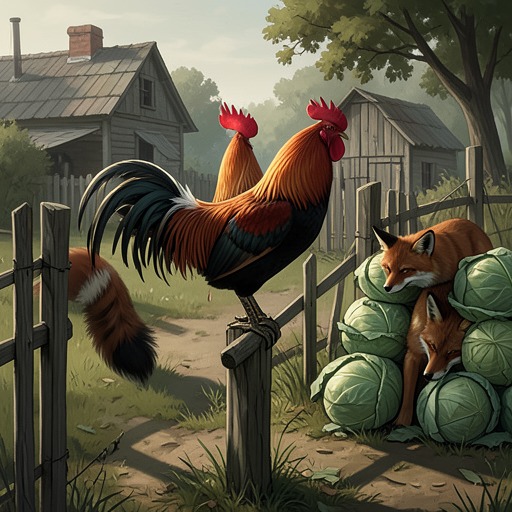
Russell enters the relationship as an established threat rather than an accidental intruder. He has been living in the nearby grove for three years, hidden within the landscape before Chanticleer notices him. The narration presents his presence as part of a larger design, yet his immediate conduct is unmistakably practical: he lies low beside the cabbage bed, waiting for an opportunity. His concealment gives him the first advantage, since Chanticleer sees him only while looking across the garden to catch a butterfly.
The first sight of Russell exposes the imbalance between them. Chanticleer has never laid eyes on the fox before, and the discovery is alarming enough that he would have departed at once if Russell had not spoken. Russell therefore adds verbal manipulation to physical ambush. He addresses the rooster as “Gentle sir,” asks what is the matter, and claims, “I am your friend—are you afraid of me?” The false friendliness is not evidence of fellowship; it is the opening move of the fox’s attack, designed to turn immediate fear into hesitation.
Flattery as a Weapon
Russell’s method depends on making Chanticleer participate in his own danger. Instead of pursuing the rooster openly, he presents himself as a courteous acquaintance and uses praise to suspend suspicion. The broader narration warns against the treachery of flatterers, placing this encounter within a moral pattern that extends beyond animals. Russell’s language is dangerous precisely because it sounds civil: courtesy becomes camouflage, and apparent friendship becomes a means of disarming an enemy.
Chanticleer’s response reveals how easily pride can be drawn into the trap. He stands high on his toes, stretches his neck, closes his eyes, and begins to crow loudly. The gesture is both a display of confidence and a failure of vigilance. Russell’s speech has not made the fox safe; it has made Chanticleer eager to demonstrate superiority. The rooster’s body rises as his awareness falls, and the predator benefits from that misplaced self-regard.
Capture and Reversal
The relationship reaches its most extreme point when Russell succeeds in taking Chanticleer. The rooster is no longer merely threatened or deceived; he lies on the fox’s back and remains within the reach of the fox’s jaws. At this stage the predator appears to have completed the movement from hidden observer to master of the scene. Chanticleer’s fear remains, but it does not prevent him from thinking and speaking.
The reversal begins when Chanticleer turns Russell’s vanity against him. Despite his fear, the rooster tells the fox what he would do if he were in Russell’s position: he would eat the captive immediately in front of an observer. Russell accepts the suggestion, replying that this is indeed what he will do. His answer shows that the fox is still governed by appetite and self-display; he must voice the victory instead of silently securing it.
As Russell speaks, Chanticleer breaks free from the fox’s jaws without a pause and flies high into a tree. The escape is therefore caused not by superior strength but by a failure of discipline. Russell has captured Chanticleer through calculated deception, yet loses him because he responds to the rooster’s provocation and opens his jaws at the decisive moment. The predator’s confidence becomes the mechanism of his defeat.
Conflict and Narrative Significance
Russell and Chanticleer do not develop a reciprocal bond. Their relationship remains antagonistic from beginning to end: one seeks to eat, while the other seeks to survive. The language of friendship is exposed as a predatory fiction, and the apparent hierarchy between cunning fox and vulnerable rooster is overturned by a brief exchange of rhetoric. Chanticleer’s escape does not erase the danger of Russell; it demonstrates instead that danger can be resisted when the victim recognizes how the aggressor’s pride operates.
The encounter also links bodily action with verbal power. Russell’s low posture in the cabbage bed, Chanticleer’s elevated stance and closed eyes, the fox’s jaws, and the rooster’s sudden flight create a visible sequence of concealment, exposure, capture, and release. Speech governs every transition: Russell’s greeting delays escape, his flattery elicits the crow, and Chanticleer’s calculated advice prompts the opening through which he escapes. The relationship thus functions as a moral exemplum about flattery and vigilance, while its comic ending makes the lesson memorable: the fox possesses the stronger body, but the rooster survives by exploiting the fox’s need to hear himself praised and to announce his triumph.